Top 10 Tools Every SOC Analyst Should Master in 2026
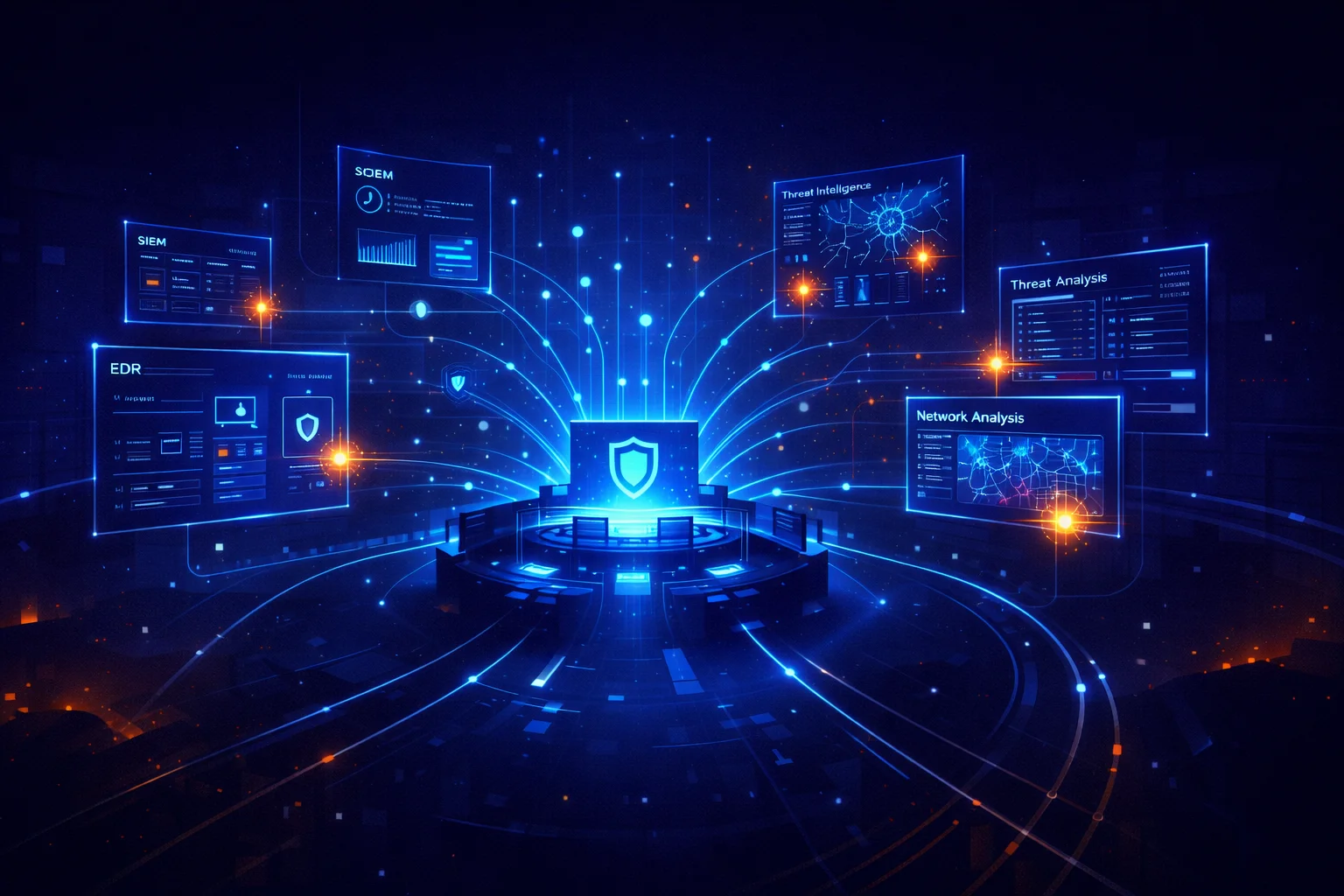
Top 10 Tools Every SOC Analyst Should Master in 2026

Manoj Sharma
Founder & Lead Coach · CISSP, CCSP, CISM, CRISC
Quick Answer
Which tools should a SOC analyst master in 2026?
The ten tools every SOC analyst should master in 2026: Splunk (SIEM; SPL is a hiring filter), Microsoft Sentinel (cloud-native SIEM; KQL), Wireshark (network protocol analysis), Carbon Black under Broadcom (EDR — no longer VMware; now part of Symantec CBX), Kali Linux (attacker perspective and purple-team validation), CrowdStrike Falcon (cloud-native NGAV and EDR), TheHive (open-source incident response platform), IBM QRadar and LogRhythm (alternative SIEMs dominant in banking and enterprise), Tanium (real-time endpoint visibility at scale), and Threat Intelligence Platforms including ThreatConnect, Anomali and open-source MISP. Also essential: MITRE ATT&CK, SOAR, Sysmon, Zeek/Suricata, Velociraptor and YARA. The recommended learning order is one SIEM deeply, then Wireshark, MITRE ATT&CK, one EDR, then TheHive and MISP. Depth beats breadth. CISSP suits senior and lead SOC roles rather than entry level. Cybernous, led by instructor Manoj Sharma, coaches CISSP with a 98.3% organisational CISSP first-attempt pass rate.
As the cybersecurity landscape evolves, so does the role of a SOC analyst. In 2026, staying on top of emerging threats and learning to leverage the right tools is more crucial than ever.
The Security Operations Centre (SOC) is the first line of defence against cyberattacks, and the tools an analyst uses make all the difference in effectively detecting, analysing and responding to threats. If you plan to advance in this field, mastering the right tools is essential.
Below are the ten tools every SOC analyst should be proficient in by 2026 — grouped by what they actually do, because that matters more than the vendor names.
Tools change. Categories do not. Every item below belongs to one of five functions: SIEM (aggregate and correlate logs), EDR/XDR (watch and respond on endpoints), network analysis (see the traffic), incident response (manage the case), and threat intelligence (know the adversary). Learn the category deeply and the specific product becomes a matter of syntax. Employers hire for the former and train for the latter.
| # | Tool | Category | Why it matters |
|---|---|---|---|
| 1 | Splunk | SIEM | Most requested SIEM in job listings; SPL is a hiring filter |
| 2 | Microsoft Sentinel | Cloud-native SIEM | Fastest-growing in Azure-heavy orgs; KQL in demand |
| 3 | Wireshark | Network analysis | Packet-level ground truth; free and universal |
| 4 | Carbon Black (Broadcom) | EDR / XDR | Endpoint visibility and response at enterprise scale |
| 5 | Kali Linux | Offensive / validation | Attacker perspective; purple-team validation |
| 6 | CrowdStrike Falcon | EDR / NGAV | Market-leading cloud-native endpoint protection |
| 7 | TheHive | Incident response (SIRP) | Open-source case management and SOC collaboration |
| 8 | IBM QRadar & LogRhythm | Alternative SIEMs | Still dominant in banking and large enterprises |
| 9 | Tanium | Endpoint visibility | Real-time query and control at massive scale |
| 10 | Threat Intelligence Platforms | Threat intel | Move from reacting to anticipating |
1. Splunk
Splunk remains one of the top tools for data analysis, security monitoring and incident response. It provides deep insights into log data from multiple sources such as network devices, endpoints and applications. SOC analysts use Splunk's Search Processing Language (SPL) to identify patterns, detect anomalies and generate security reports. With its extensive ecosystem of apps, Splunk is indispensable for modern security operations — and in Indian job listings especially, it is the most frequently requested SIEM.
The value in Splunk is not the interface — it is SPL. An analyst who can write a correlation search, tune a noisy detection and build a dashboard is doing engineering work. An analyst who can only click through saved searches is doing data entry. Interviewers know the difference and they ask. The same applies to Sentinel and KQL.
2. Microsoft Sentinel
Formerly known as Azure Sentinel, Microsoft Sentinel is a cloud-native SIEM gaining rapid adoption. Its key strengths are seamless integration with Microsoft products, built-in machine learning and automation, and threat-intelligence-driven detection. For organisations already invested in the Microsoft ecosystem, the integration advantage is decisive — which is why Sentinel skills, and its KQL query language, are climbing job descriptions faster than any other SIEM in 2026.
3. Wireshark
Network traffic analysis is a core SOC skill, and Wireshark remains one of the most powerful network protocol analysers available. It helps analysts capture live network traffic, analyse packets at a granular level, and identify malicious or unauthorised activity. Understanding network behaviour is crucial when hunting advanced threats — and when a SIEM alert is ambiguous, packets are the ground truth that settles the argument. It is also free, which means there is no excuse for not practising with it tonight.
4. Carbon Black (Broadcom)
Carbon Black is a long-established Endpoint Detection and Response (EDR) platform providing continuous endpoint visibility, real-time threat detection, and rapid incident investigation and response. It is especially effective against advanced persistent threats (APTs) and malware.
You will still see it called that everywhere, and it is out of date. VMware acquired Carbon Black in 2019, but Broadcom acquired VMware in November 2023 and subsequently merged Carbon Black with Symantec into a new Enterprise Security Group. The consolidated offering now ships as Symantec CBX, fusing Carbon Black XDR with Symantec's prevention capabilities. If you say "VMware Carbon Black" in an interview at an enterprise shop, someone will notice. Say Broadcom.
5. Kali Linux
Kali Linux is a widely used penetration testing and security auditing operating system. SOC analysts use it to perform vulnerability assessments, test network defences and simulate real-world attacks. With over 600 preinstalled security tools, it helps organisations identify weaknesses before attackers do.
Be clear-eyed about why this belongs on a defensive list, though. Kali is not a daily SOC tool — most analysts will not open it on shift. Its value is perspective: purple-team exercises, validating that your detections actually fire, and understanding what an attack looks like from the other side of the keyboard. An analyst who has run the attack recognises it far faster in the logs. That is the reason to learn it, and it is a good one.
6. CrowdStrike Falcon
CrowdStrike Falcon is a cloud-native endpoint protection platform combining next-generation antivirus (NGAV), Endpoint Detection and Response (EDR), and managed threat hunting. Its AI-driven detection capabilities make it a leading choice as endpoint threats grow more sophisticated, and it is one of the most commonly encountered EDR platforms in global security operations centres — which makes familiarity with it directly employable.
7. TheHive
TheHive is an open-source Security Incident Response Platform (SIRP) designed for SOC collaboration. It enables teams to manage and track incidents, assign and escalate tasks, and integrate with other security tools. TheHive improves coordination and efficiency during incident response — and because it is open source, it is one of the few enterprise-grade SOC tools you can genuinely run at home to learn on. Pair it with Cortex for automated analysis and MISP for threat intel, and you have a working home lab that mirrors a real SOC workflow.
8. IBM QRadar and LogRhythm (Alternative SIEMs)
Splunk and Sentinel are not the only SIEMs you will meet. IBM QRadar and LogRhythm remain foundational in banking, government and large traditional enterprises, and they allow analysts to aggregate logs from multiple sources, correlate events across systems and detect threats in real time.
The practical guidance: mastering at least one SIEM solution deeply is essential for SOC analysts in 2026 — but do not try to master all four. The concepts transfer almost entirely; only the query syntax changes. An analyst fluent in SPL learns KQL in weeks. An analyst fluent in neither learns nothing quickly.
9. Tanium
Tanium provides real-time visibility and control across enterprise endpoints, with rapid vulnerability detection, endpoint activity monitoring and automated response capabilities. Its unique architecture — a linear chain that queries endpoints peer-to-peer rather than through a central server — delivers speed and scale, making it ideal for very large organisations where asking a question of 500,000 machines needs to return an answer in seconds rather than hours.
10. Threat Intelligence Platforms (TIPs)
Threat Intelligence Platforms such as ThreatConnect and Anomali help SOC teams stay ahead of attackers. They allow analysts to aggregate threat intelligence from multiple sources, track threat actors and attack trends, and identify indicators of compromise (IOCs). TIPs enable proactive defence rather than reactive response. MISP is the open-source option and is worth knowing precisely because you can run it yourself.
The skill that makes a TIP valuable is not the platform — it is fluency in MITRE ATT&CK. Intelligence without a framework to organise it is just a list of bad IP addresses. ATT&CK is what turns it into a threat model.
Worth Knowing Beyond the Ten
The list above covers what employers ask for by name. These are the ones that quietly separate strong analysts from average ones.
| Tool / Framework | What it gives you |
|---|---|
| MITRE ATT&CK | Not a tool — the framework that structures everything else. Non-negotiable in 2026. |
| SOAR platforms | Automating the repetitive triage that burns analysts out |
| Sysmon | Free, deep Windows endpoint telemetry — the logs you wish you had after an incident |
| Zeek / Suricata | Open-source network monitoring and IDS; Wireshark at scale |
| Velociraptor | Open-source endpoint forensics and hunting |
| YARA | Writing your own malware detection rules |
| MISP | Open-source threat intel sharing — the free TIP |
Which Should You Learn First?
Ten tools is a reading list, not a study plan. If you are starting out, here is the order that actually gets you hired.
- One SIEM, deeply. Splunk or Sentinel. Learn the query language until you can write a correlation search from scratch. This single skill does more for your employability than the other nine combined.
- Wireshark. It is free, it teaches you what normal looks like, and you cannot spot abnormal without that.
- MITRE ATT&CK. The vocabulary every serious conversation uses.
- One EDR. CrowdStrike or Carbon Black — whichever you can get access to.
- TheHive + MISP. Free, self-hostable, and they teach you the workflow rather than a vendor's menu.
Two analysts with identical tenure can be separated by a wide salary gap, and it is rarely the length of their tool list that decides it. It is depth in one SIEM, the ability to own an investigation end to end, and ATT&CK fluency. Depth beats breadth every time. Knowing two or three tools well enough to discuss confidently in an interview puts you ahead of most candidates who list ten and can demonstrate none.
Bonus: CISSP Training for Career Growth
As cyber threats become more complex, demand for highly skilled SOC analysts continues to rise. The CISSP (Certified Information Systems Security Professional) certification is globally recognised and validates deep expertise in information security management. For SOC analysts, it strengthens foundational security knowledge, improves career prospects and provides a competitive edge in the job market.
Be realistic about where CISSP fits. It is not an entry-level credential — it requires five years of relevant paid experience (four with a degree or approved credential waiver), and L1 SOC roles are better served by CompTIA Security+ plus hands-on tool skill. CISSP becomes genuinely valuable as you move toward senior analyst, SOC lead, SOC manager or security architect, where it validates the governance, risk and strategy expertise that separates a leader from an operator. If you are early in the journey, you can still sit the exam and hold Associate of ISC2 status while you accrue the experience.
Conclusion
In 2026, proficiency in these ten tools will help SOC analysts stay ahead in an ever-evolving security landscape — whether that is using SIEM platforms like Splunk or Microsoft Sentinel, analysing traffic with Wireshark, or protecting endpoints with CrowdStrike. These tools significantly enhance a SOC analyst's effectiveness.
But hold on to the principle underneath the list: tools are how you execute, not how you think. The analyst who understands why a detection fires will outlast every product cycle. Learn one SIEM properly, get fluent in ATT&CK, build a home lab you actually break things in — and let the vendor names come and go. Stay current, keep learning, and invest in the depth that compounds.
From SOC Tooling to the CISSP
Turn hands-on skills into a globally recognised certification. The Cybernous CISSP Success Toolkit is a mentored 100-day programme — 60+ hours of live practice, 5,045+ questions and 1:1 coaching from Manoj Sharma. 2,000+ certified across 40+ countries, 98.3% organisational CISSP first-attempt pass rate.
Train for CISSP Certification →
Continue Reading
- SOC analyst career path: skills, certifications and salary
- Become the next SOC analyst in just 90 days
- SOC analyst: your first step toward a powerful cybersecurity career
- Top 10 highest paying cybersecurity jobs in India
- The CISSP Success Toolkit — Mission CISSP 100 Days
- The CISM Success Toolkit — governance-first coaching
- Free CISSP & CISM practice questions
- CISSP & CISM domain summaries for rapid revision
- Meet your coach, Manoj Sharma
- Book a free 20-minute career strategy call
Frequently Asked Questions
You might also like


Ready to accelerate your certification journey?
Join Cybernous' structured programme with live mentoring, hands-on practice, and a proven track record.