Top Cybersecurity Certifications in 2026: Your Complete Career Guide
Top Cybersecurity Certifications in 2026: Your Complete Career Guide

Manoj Sharma
Founder & Lead Coach · CISSP, CCSP, CISM, CRISC
Quick Answer
Which are the top cybersecurity certifications to pursue in 2026, and which one is right for you?
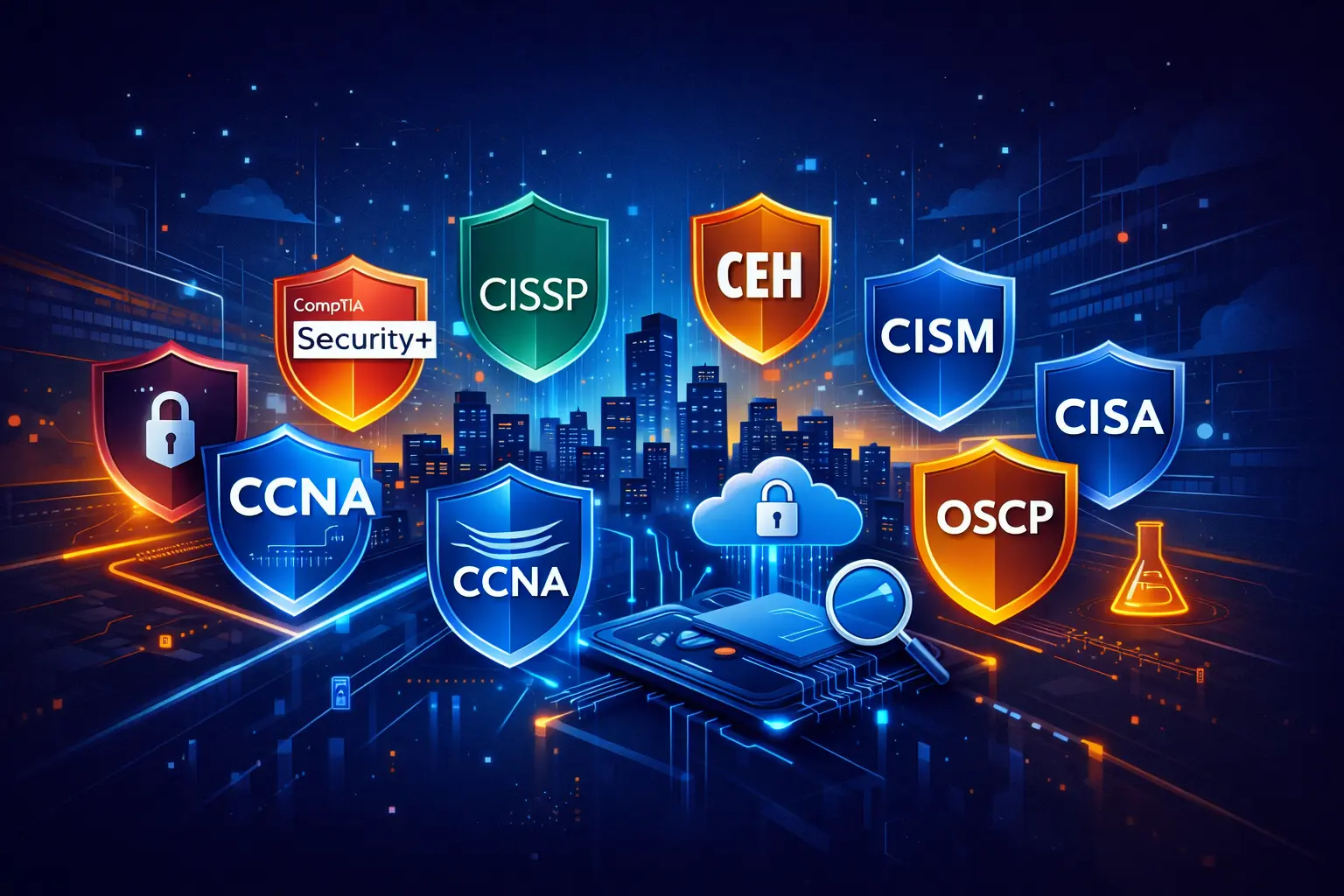
The top cybersecurity certifications in 2026 map to career stage and direction rather than a single ranking. For entry, CompTIA Security+ is the vendor-neutral baseline, with Cisco CCNA useful for a networking foundation. For security leadership and governance, CISM (four domains, management focus), CISSP (eight domains, the broad gold standard) and CISA (five domains, audit and assurance) lead. For offensive security, CEH v13 — EC-Council's first AI-integrated version — and the hands-on OSCP+ are the recognised credentials. For cloud, ISC2's CCSP (six domains, updated 1 August 2026 with AI woven throughout) is the specialist standard. The newest and fastest-growing category is AI security: securing AI systems, LLM security and AI governance, addressed by dedicated programmes such as Cybernous's GAESP. The right choice depends on whether you are entering the field, moving into management, going offensive, specialising in cloud, or building AI-security skills.
Cybersecurity is one of the most vital fields in today's hyperconnected world, and as threats grow more advanced, demand for skilled professionals keeps rising. If you're considering — or advancing — a career in the field, the right certification establishes your credibility and unlocks long-term opportunity. This guide covers the top cybersecurity certifications in 2026, grouped by career stage, with clear guidance on which one fits where you are and where you're going.
Certifications aren't a single ladder — they're a map with several routes. Broadly there are five: entry (prove fundamentals), management & governance (lead security programmes), offensive (attack to defend), cloud (secure cloud environments), and the newest, AI security (secure AI systems). Pick the route that matches your direction first; the specific certification within it comes second.
The 2026 Certifications at a Glance
Here is the landscape in one view — what each certification proves, its level, and who it suits:
| Certification | Body | Route | Level | Best For |
|---|---|---|---|---|
| CompTIA Security+ | CompTIA | Entry | Entry | Newcomers building fundamentals |
| Cisco CCNA | Cisco | Entry (networking) | Entry | Network/infrastructure foundation |
| CISM | ISACA | Management | Senior | Security managers & governance |
| CISSP | ISC2 | Management | Senior | Broad security leadership (gold standard) |
| CISA | ISACA | Audit | Senior | IS audit, control & assurance |
| CEH v13 | EC-Council | Offensive | Mid | Ethical hacking, now AI-integrated |
| OSCP+ | OffSec | Offensive | Mid–advanced | Hands-on penetration testing |
| CCSP | ISC2 + CSA | Cloud | Senior | Cloud security specialists |
| AI-security path (e.g. GAESP) | Various | AI security | Mid–senior | Securing AI/LLM systems (2026's growth area) |
What a Cybersecurity Certification Actually Does
A certification is more than a credential — it's a signal of trust and capability. It shows the holder has proven technical knowledge, understands their ethical responsibility, and has the practical grounding to protect critical systems. For employers, that's assurance that digital assets are in capable hands. But — and this matters — a certification proves you've demonstrated knowledge under exam conditions; it doesn't replace the hands-on experience that actually does the job. The strongest professionals pair the right credential with real practice.
Entry-Level: Where to Start
CompTIA Security+
Often considered the entry point into cybersecurity, Security+ is vendor-neutral and — despite the "entry-level" label — provides comprehensive coverage of the essentials:
- Network security — securing networks and devices
- Cryptography — encryption methods and protocols
- Risk management — identifying, assessing and controlling security risks
Its vendor-neutral nature makes it ideal for professionals working across many technologies, and it's the natural first credential for most newcomers.
Cisco CCNA
CCNA is a strong foundation for anyone interested in network and infrastructure security, covering network fundamentals, device security, IPv4/IPv6, IP services (DNS, DHCP), security basics, and network automation. Note that it's a networking credential rather than a security-specific one — but the networking grounding it gives is genuinely valuable for a security career.
Management & Governance: Leading Security
CISSP — Certified Information Systems Security Professional
Widely regarded as the gold standard, CISSP (from ISC2) spans eight domains: Security and Risk Management; Asset Security; Security Architecture and Engineering; Communication and Network Security; Identity and Access Management; Security Assessment and Testing; Security Operations; and Software Development Security. CISSP-certified professionals are prized for their broad expertise across governance, architecture and operations. It requires five years of experience — so it's a target to build toward, not a first cert. See why CISSP is hard, and how to pass first attempt.
CISM — Certified Information Security Manager
CISM (from ISACA) is built for professionals who manage and govern information security programmes, across four domains: Information Security Governance; Information Risk Management; Information Security Program Development and Management; and Information Security Incident Management. It's the manager's credential — ideal for leadership, governance and compliance-focused roles. Weighing it against CISSP? Our CISSP vs CISM comparison lays out the choice.
CISA — Certified Information Systems Auditor
CISA (from ISACA) is ideal for auditing, control and assurance of information systems, across five domains: the Information Systems Auditing Process; Governance and Management of IT; Information Systems Acquisition, Development and Implementation; Information Systems Operations and Business Resilience; and Protection of Information Assets. It's the credential of choice for audit and assurance careers.
Offensive Security: Attack to Defend
CEH v13 — Certified Ethical Hacker
CEH (from EC-Council) is for professionals who want a deep understanding of hacking techniques and vulnerabilities, certifying them as ethical (white-hat) hackers. The current version, CEH v13, is EC-Council's first AI-integrated release — alongside the classic methodology (reconnaissance, scanning, gaining access, maintaining access, covering tracks) it now covers AI-assisted attacks, defending AI models, and threats like prompt injection and model poisoning. It's widely recognised by employers and government recruiters, making it a strong structured entry into offensive security.
OSCP+ — Offensive Security Certified Professional
OSCP is the certification penetration-testing hiring managers respect most, and since November 2024 the updated exam earns the OSCP+ designation (with three-year validity). It's hard on purpose: the exam is roughly 23 hours 45 minutes of live hacking against a target network, followed by 24 hours to write a professional report — no multiple choice, and around 70% of candidates fail their first attempt. Active Directory attack chains are now central. It's the hands-on proof for serious offensive roles, and the on-ramp to advanced OffSec certs like OSEP and OSWE.
Cloud Security
CCSP — Certified Cloud Security Professional
As organisations migrate to the cloud, demand for cloud-security expertise keeps growing, and CCSP (from ISC2, developed with the Cloud Security Alliance) is the specialist standard, across six domains: cloud architecture and design; cloud data security; cloud platform and infrastructure security; cloud application security; cloud operations; and legal, risk and compliance. Two things to know for 2026: the CCSP outline was updated on 1 August 2026 to weave AI security across all six domains, and an active CISSP waives the entire CCSP experience requirement — ISC2 designed the two to stack.
AI Security: The Fastest-Growing Route in 2026
This is the category the old certification lists miss — and the one growing fastest. As organisations deploy AI far quicker than they can secure it, a distinct discipline has emerged around securing AI systems: LLM security, prompt injection defence, the OWASP Top 10 for LLMs, MITRE ATLAS, and AI governance frameworks (NIST AI RMF, ISO 42001, the EU AI Act). You can see the mainstream certifications responding — CEH v13 added AI-attack modules; the 2026 CCSP outline wove AI throughout. And dedicated programmes now target this skill set directly, including Cybernous's GenAI Expert (GAESP).
If you want the clearest edge on a 2026 CV, build AI-security skills. The demand-to-supply gap is widest here: organisations everywhere are adopting AI, but few people can actually secure it. Whether you approach it through a dedicated programme like GAESP or by adding the AI modules now inside CEH v13 and CCSP, understanding LLM security and AI governance is the freshest, scarcest skill you can put on your CV right now.
Which Certification Should You Choose?
Match your goal to a route, then pick within it:
| If Your Goal Is… | Start With… | Cybernous Course |
|---|---|---|
| Breaking into cybersecurity | CompTIA Security+ | First-step guide |
| Broad security leadership | CISSP | CISSP Success Toolkit |
| Security management / governance | CISM | CISM Success Toolkit |
| Audit & assurance | CISA | CISA programme |
| Cloud security | CCSP | CCSP Success Toolkit |
| Offensive / penetration testing | CEH v13 → OSCP+ | Offensive Security |
| AI security (2026 growth area) | AI-security path | GenAI Expert (GAESP) |
More certifications is not automatically better. Employers value depth and a coherent path over a scattered list of unrelated badges. A focused sequence — Security+ → CISSP for leadership, or CEH v13 → OSCP+ for offensive — beats an alphabet soup of half-related certs every time. Add a credential when it genuinely advances your direction or opens a specific door, not just because it exists.
Don't skip stages. Senior certs like CISSP and CCSP need years of experience, and OSCP+ will overwhelm someone who's never enumerated a box. Build fundamentals first (Security+), gain hands-on experience, then layer on the credential that matches your chosen route. The path matters as much as the destination — and it's far more convincing to an interviewer than a rushed collection.
Conclusion
Staying ahead in cybersecurity means choosing credentials deliberately. Whether your interests lie in network security, risk management, ethical hacking, governance, cloud, or the fast-emerging field of AI security, there's a certification aligned with your goals. But certification is only the beginning — continuous learning, hands-on experience, and staying current with evolving threats are what turn a credential into a career. Pick your route, build real skill alongside the badge, and keep moving.
Not Sure Which Certification Fits Your Path?
Cybernous coaches professionals across CISSP, CISM, CCSP, CISA, Offensive Security and the GenAI Expert (GAESP) track — with the same understand-the-why approach behind a 98.3% organisational CISSP first-attempt pass rate on our CISSP programme. Start where you are; we'll help you map the rest.
Curious about the wider job market? See growing career opportunities in cybersecurity in 2026.
Frequently Asked Questions
You might also like



Ready to accelerate your certification journey?
Join Cybernous' structured programme with live mentoring, hands-on practice, and a proven track record.